Inventory Planning Platform for Reliance Trends
Inventory Planning Platform for Reliance Trends
Inventory Planning Platform for Reliance Trends
My Role
Sole Product Designer,
from Discovery to Delivery
Current Stage
Live in 2200+
Stores across India
Product & Engineering Managers, Developers,
QA Team and Content Designer
Design Timeline
3 Weeks
1 Month (Nov'24 - Dec'24)
About the Project
The Unified Planning Platform was built for Reliance Retail’s omnichannel business, creating two critical systems Granary (AI forecasting) and A&R (allocation and replenishment) into one intelligence layer.
It aimed to enable data-driven inventory movement: predicting demand, allocating inventory, and redistributing stock in real-time to reduce waste and avoid stockouts.
The Unified Planning Platform was built for Reliance Retail’s omnichannel business, creating two critical systems Granary (AI forecasting) and A&R (allocation and replenishment) into one intelligence layer.
It aimed to enable data-driven inventory movement: predicting demand, allocating inventory, and redistributing stock in real-time to reduce waste and avoid stockouts.
Goal
Create a single Unified Retail Planning Platform (integrating assortment planning with allocation & replenishment) to automatically stock the right products in the right quantities at the right time and place, thereby boosting on-shelf availability and cutting waste.
Create a single Unified Retail Planning Platform (integrating assortment planning with allocation & replenishment) to automatically stock the right products in the right quantities at the right time and place, thereby boosting on-shelf availability and cutting waste.
Industry Insights
In retail tech, there’s a trend towards unified planning solutions that breaks down silos between merchandising and supply chain.
Traditional enterprise tools like SAP and even newer AI solutions (e.g. RELEX, o9 Solutions) offer robust planning capabilities, but often operate in separate modules or lack user-friendly UX.
Who is the User?
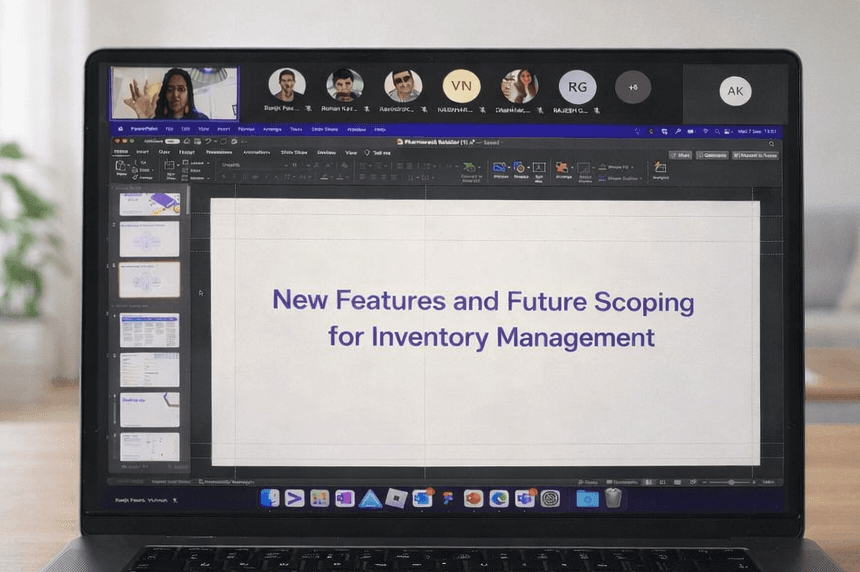
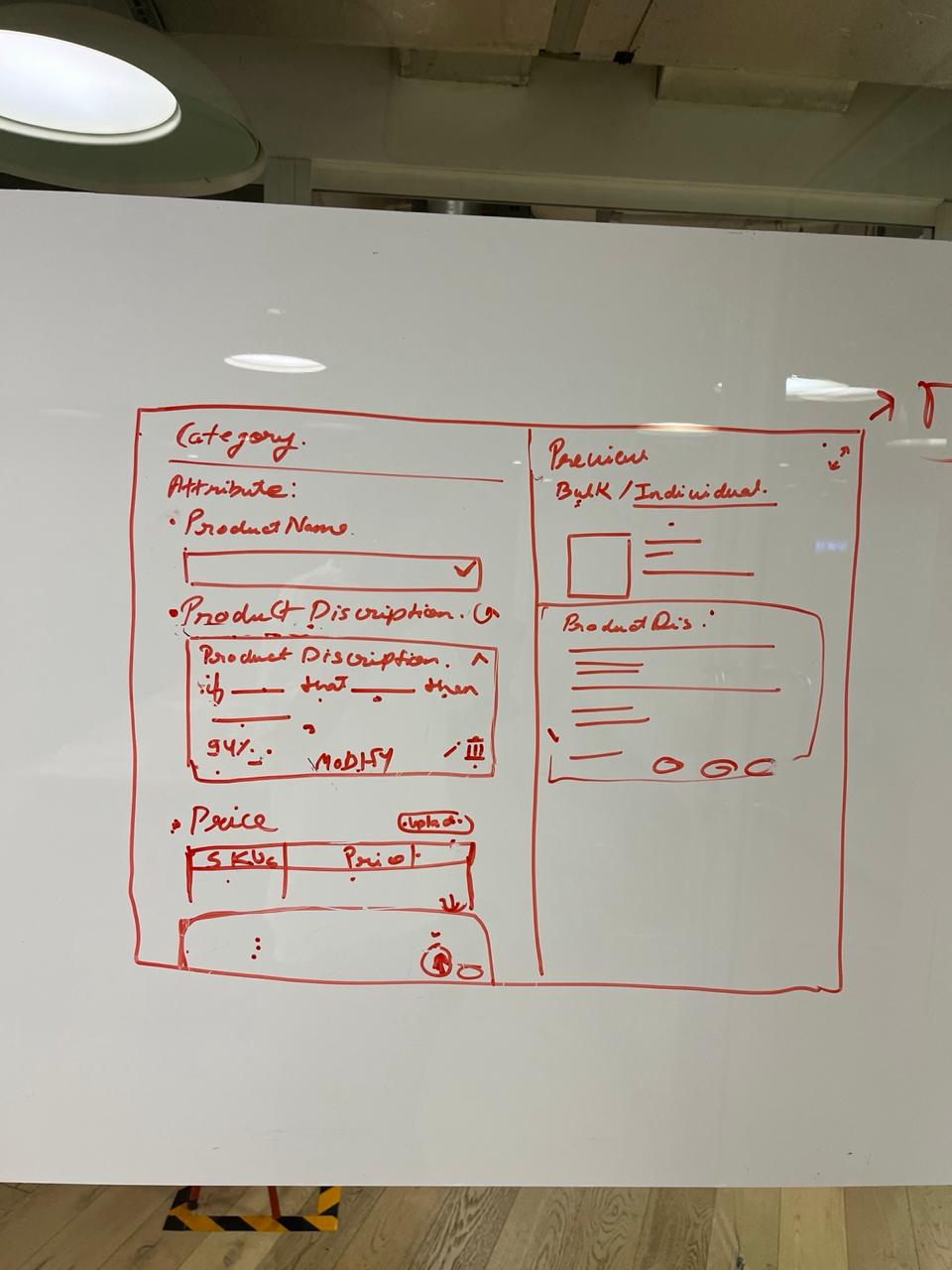
We kicked it off with a discovery phase to ground the design in real user needs and data. This included:
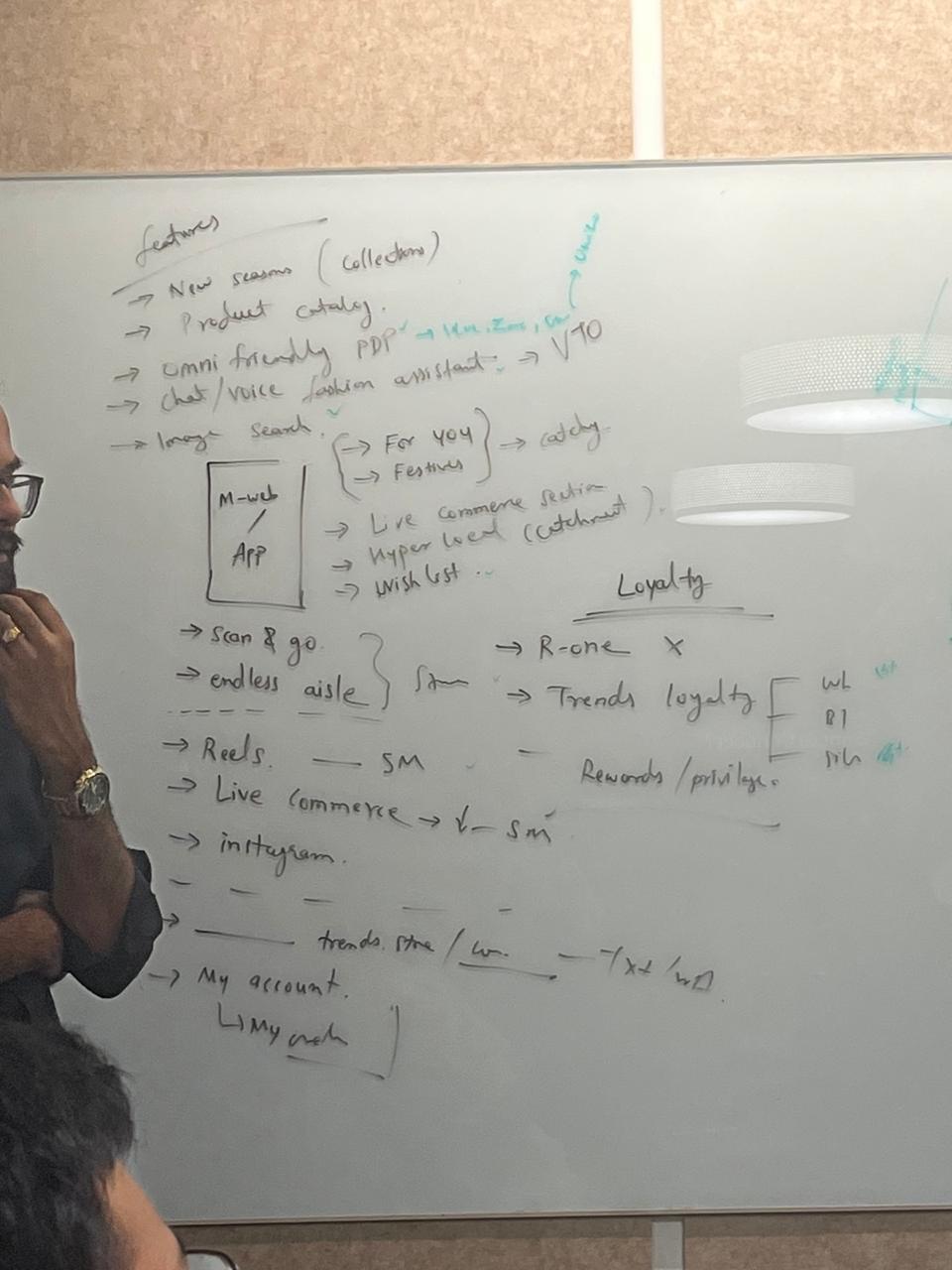
Stakeholder Workshops: Conducted 2 workshops with business leaders and the planning team to understand goals, current process pain points, and success metrics. Interviewed 6 planners and category managers (across grocery and fashion departments) to learn how they currently plan assortments and manage inventory.

Business Heads
Track KPIs like fill rate, sell-through, and aging stock

Category Managers
Monitor category health and make approval decisions

Planners
Manage store-level inventory and forecasts
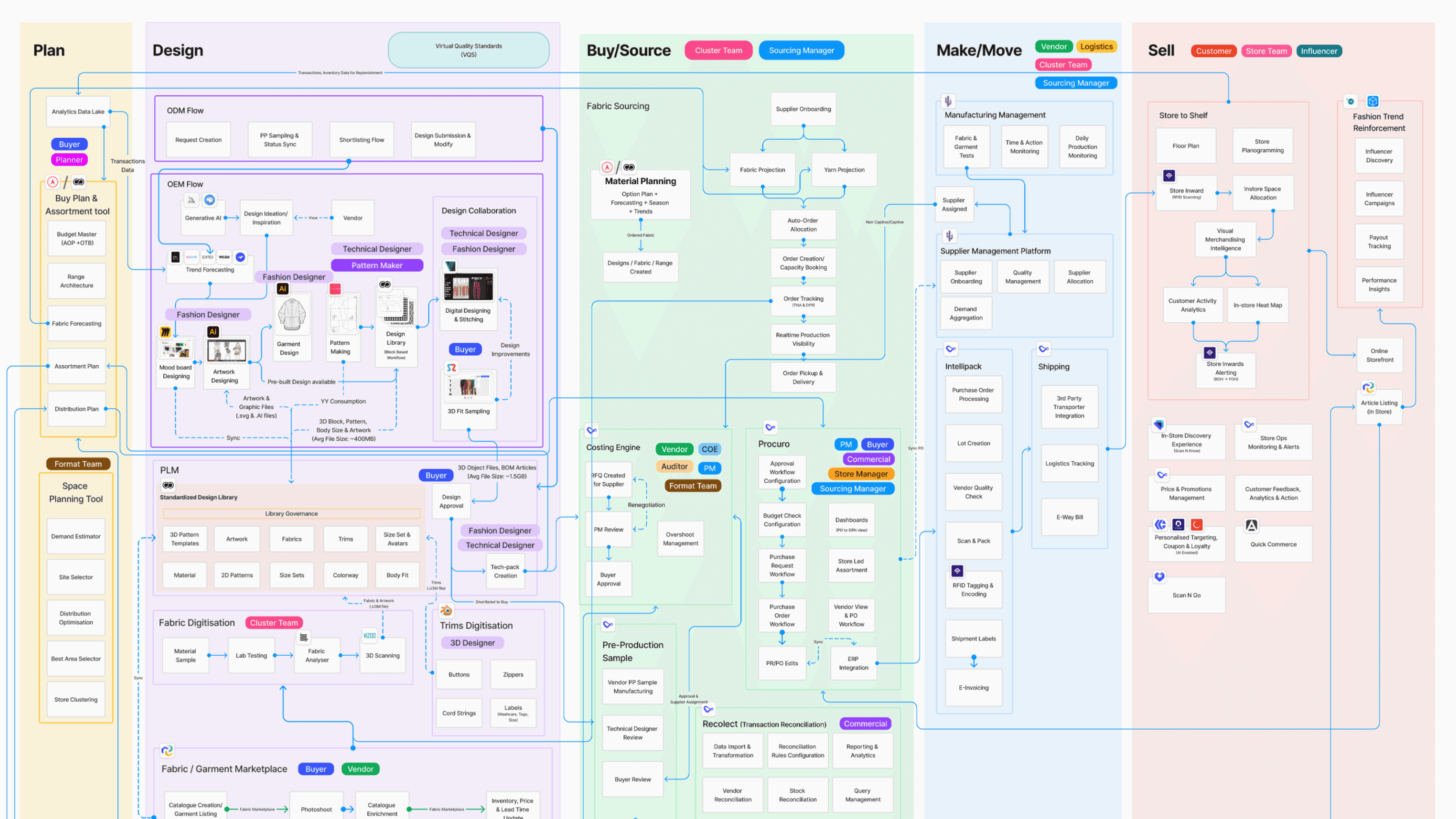
Understanding the Lifecycle of the Business
Key Painpoints
Fragmented Workflow
They had to manually transfer data between systems, causing errors and wasted time.
Lack of Visibility
Disconnected tools caused poor visibility into DC inventory, stock cover, and lead time.
Slow Reactions
Stockouts & overstocking went unnoticed for days due to delayed reports.
User Experience Gaps
The existing tools were not user-friendly and information overload on screens.
No Intelligence
No automated redistribution or pullback; aging stock was manually tracked.
Emotional Aspect
Felt frustrated they were accountable for sales but didn’t feel the tools empowered them.
Leadership Insights
Strategic Alignment
Leadership stressed the importance of one unified platform to improve cross-team alignment.
Key Metrics Focus
Leadership highlighted two critical KPIs: product availability (in-stock rate) and inventory turnover.
Change the Focus
Planners spent 70% of their time firefighting exceptions instead of planning.
UX Challenges
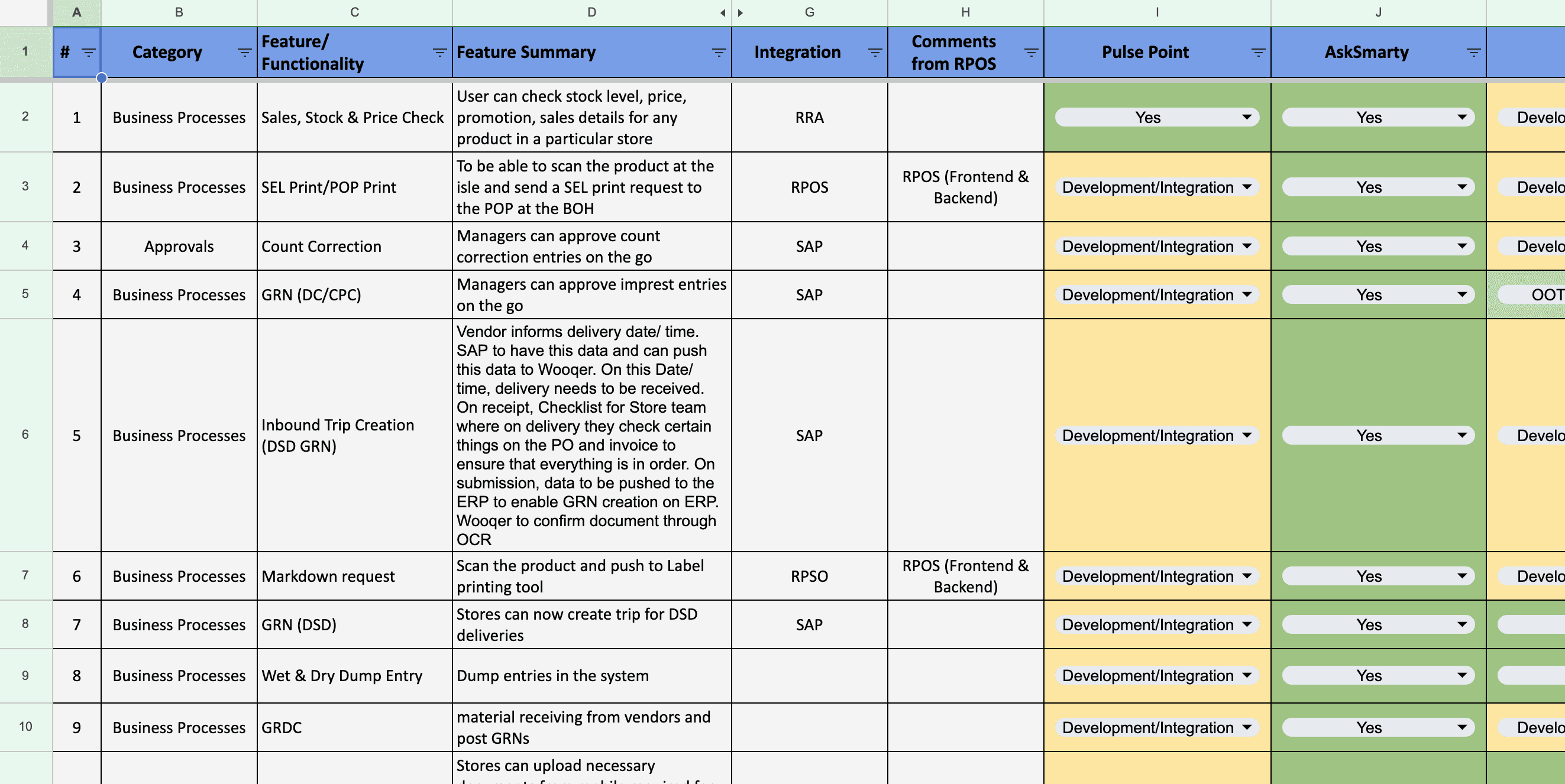
Data Density vs. Clarity
The platform deals with huge amounts of data hundreds of SKUs, dozens of stores, and forecast numbers for each.
AI Interpretability
Since the system’s recommendations come from ML models, we had to design for transparency.
User Control & Overrides
While automation is key, planners insisted on the ability to override or adjust suggestions easily.
Getting Quick Approvals
Vibe-coded the solutions for quick business approvals
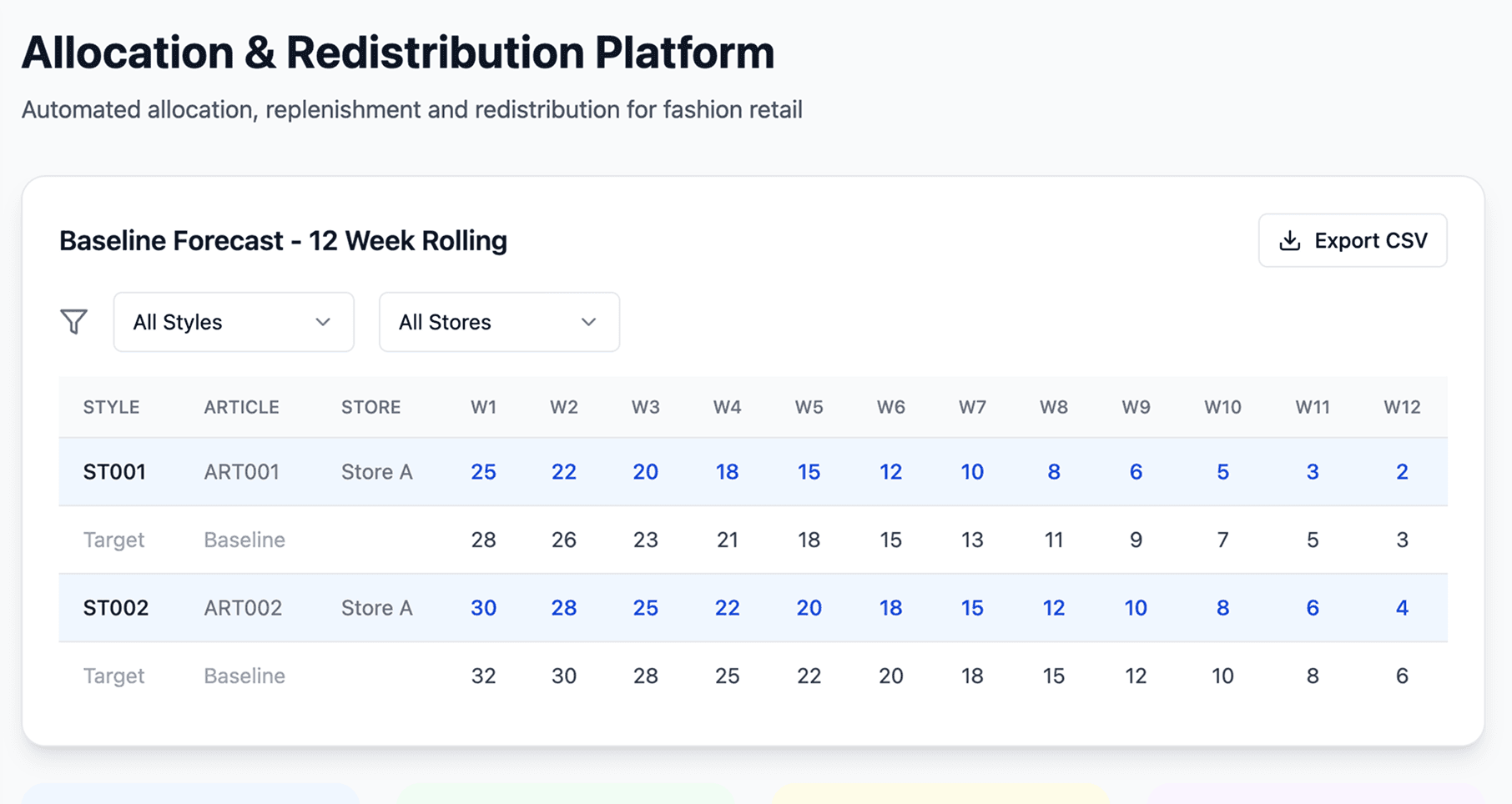
Forecasting Dashboard
Demand predictions, uncertainty bands, feature importance.
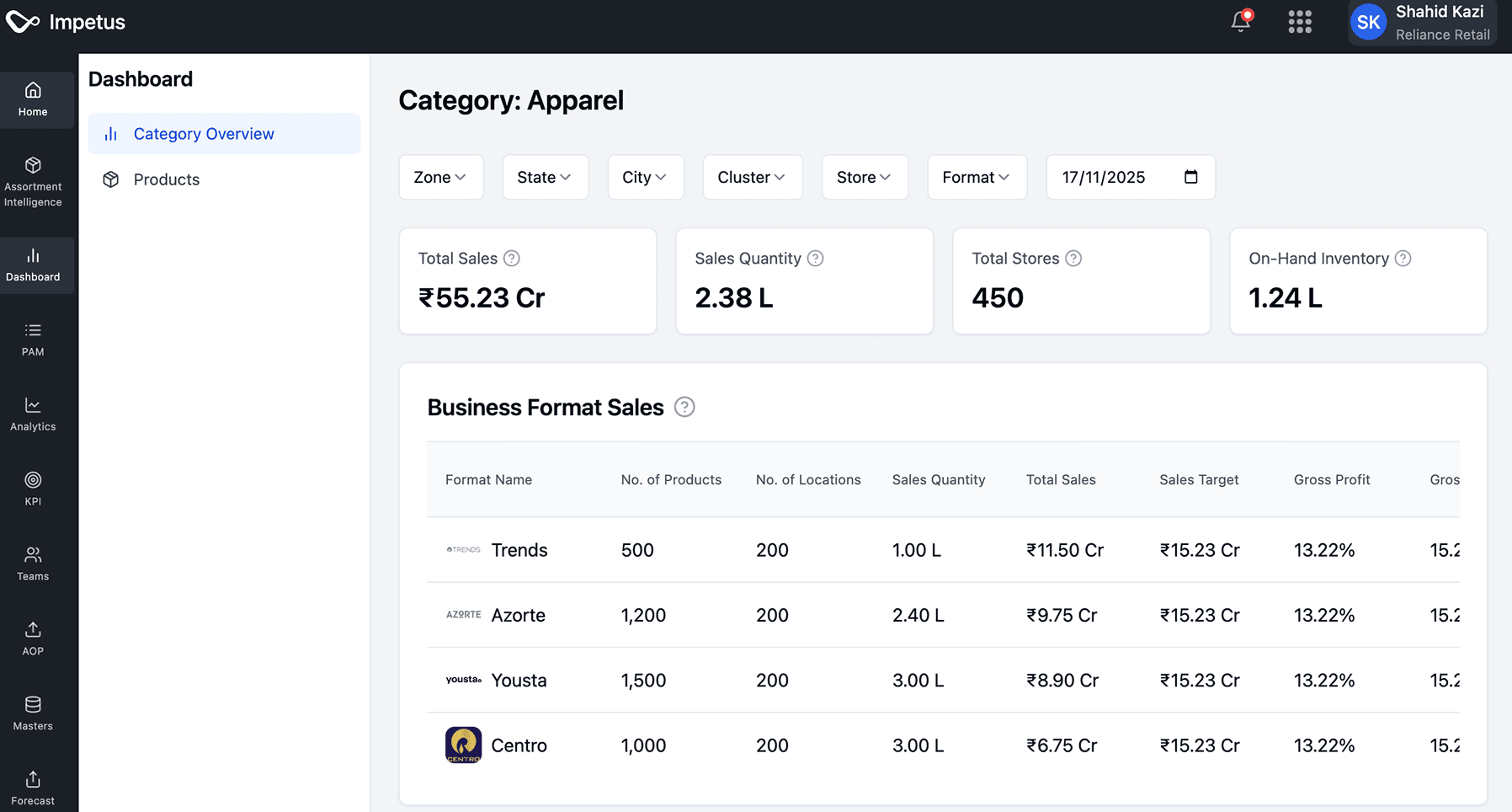
A&R Engine
Auto-runs daily replenishment and bi-weekly pullbacks with exception alerts.
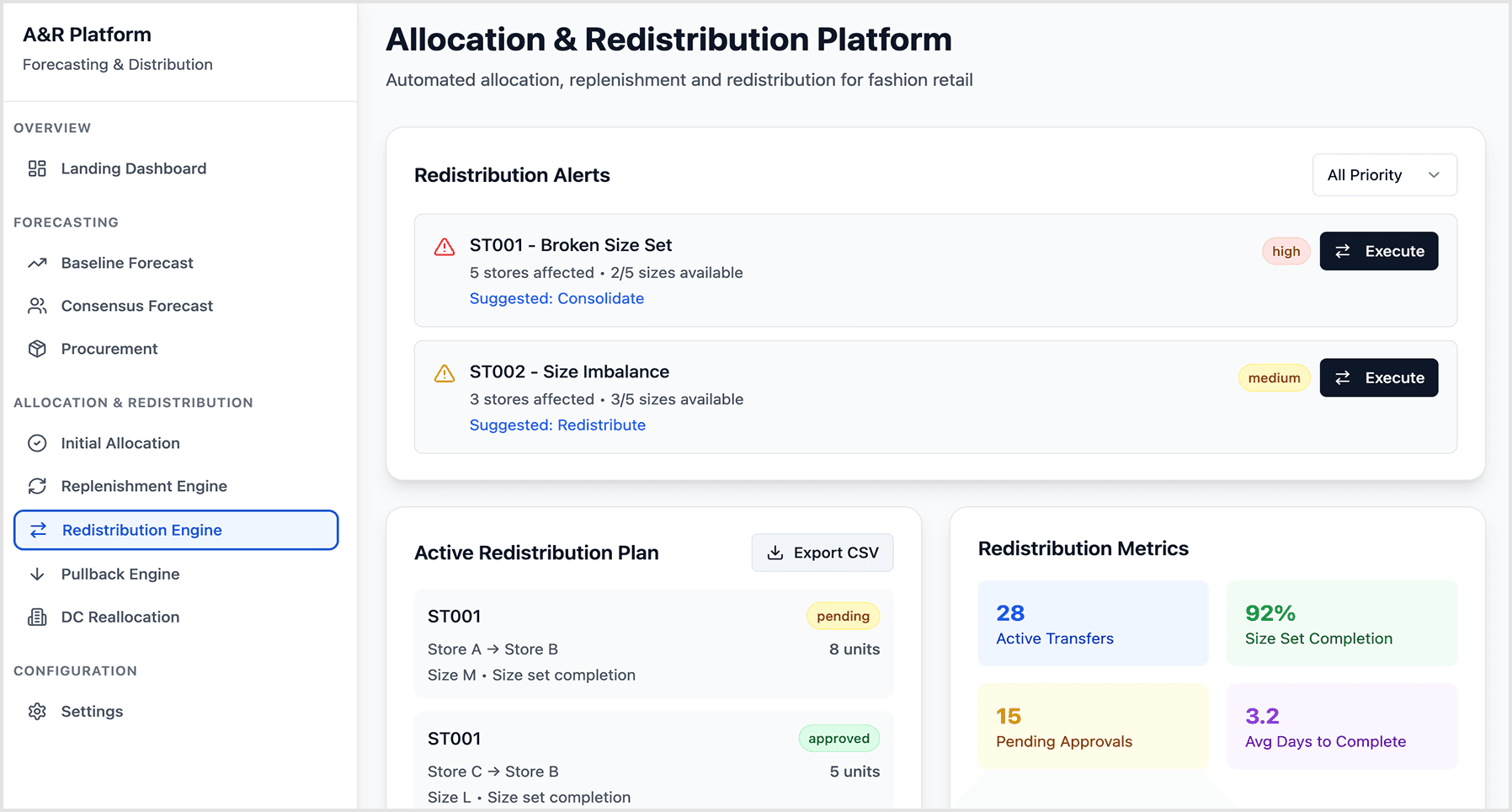
Insights & Governance Layer
KPIs, override justification, and approval workflows.
Industry Insights
In retail tech, there’s a trend towards unified planning solutions that breaks down silos between merchandising and supply chain.
Traditional enterprise tools like SAP and even newer AI solutions (e.g. RELEX, o9 Solutions) offer robust planning capabilities, but often operate in separate modules or lack user-friendly UX.
Who is the User?
We kicked it off with a discovery phase to ground the design in real user needs and data. This included:
Stakeholder Workshops: Conducted 2 workshops with business leaders and the planning team to understand goals, current process pain points, and success metrics. Interviewed 6 planners and category managers (across grocery and fashion departments) to learn how they currently plan assortments and manage inventory.
Business Heads
Track KPIs like fill rate, sell-through, and aging stock
Category Managers
Monitor category health and make approval decisions
Planners
Manage store-level inventory and forecasts
Key Painpoints
Fragmented Workflow
They had to manually transfer data between systems, causing errors and wasted time.
Lack of Visibility
Disconnected tools caused poor visibility into DC inventory, stock cover, and lead time.
Slow Reactions
Stockouts & overstocking went unnoticed for days due to delayed reports.
User Experience Gaps
The existing tools were not user-friendly and information overload on screens.
No Intelligence
No automated redistribution or pullback; aging stock was manually tracked.
Emotional Aspect
Felt frustrated they were accountable for sales but didn’t feel the tools empowered them.
Leadership Insights
Strategic Alignment
Employers are rapidly adopting automation in recruitment, 68% of companies are expected to have AI-driven hiring
Better Matching & Outcomes
69% of job seekers who used ChatGPT for their resume saw a higher response rate from employers
Recruiter Efficiency Gains
Now, algorithms can cut initial screening time by up to 75%, turning days of work into minutes
UX Challenges
Data Density vs. Clarity
The platform deals with huge amounts of data hundreds of SKUs, dozens of stores, and forecast numbers for each.
AI Interpretability
Since the system’s recommendations come from ML models, we had to design for transparency.
User Control & Overrides
While automation is key, planners insisted on the ability to override or adjust suggestions easily.
Getting Quick Approvals
Vibe-coded the solutions for quick business approvals
Forecasting Dashboard
Demand predictions, uncertainty bands, feature importance.
A&R Engine
Auto-runs daily replenishment and bi-weekly pullbacks with exception alerts.
Insights Layer
KPIs, override justification, and approval workflows.
Introducing Inventory Management System for Reliance Retail
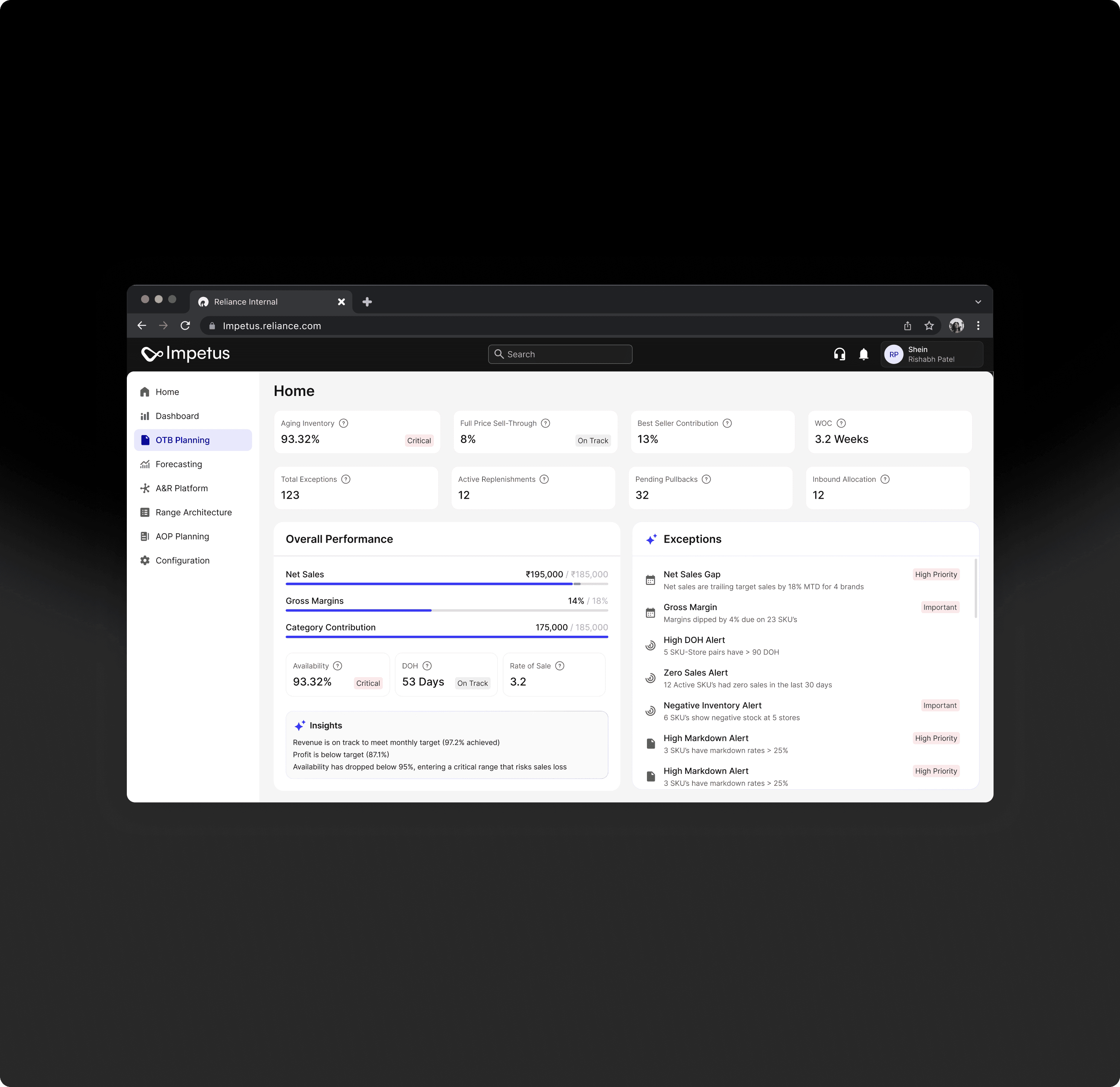
Created Home Dashboard: Unified KPI view forecast accuracy, fill rate, WOS (weeks of stock), and aged inventory.
Created Home Dashboard: Unified KPI view forecast accuracy, fill rate, WOS (weeks of stock), and aged inventory.
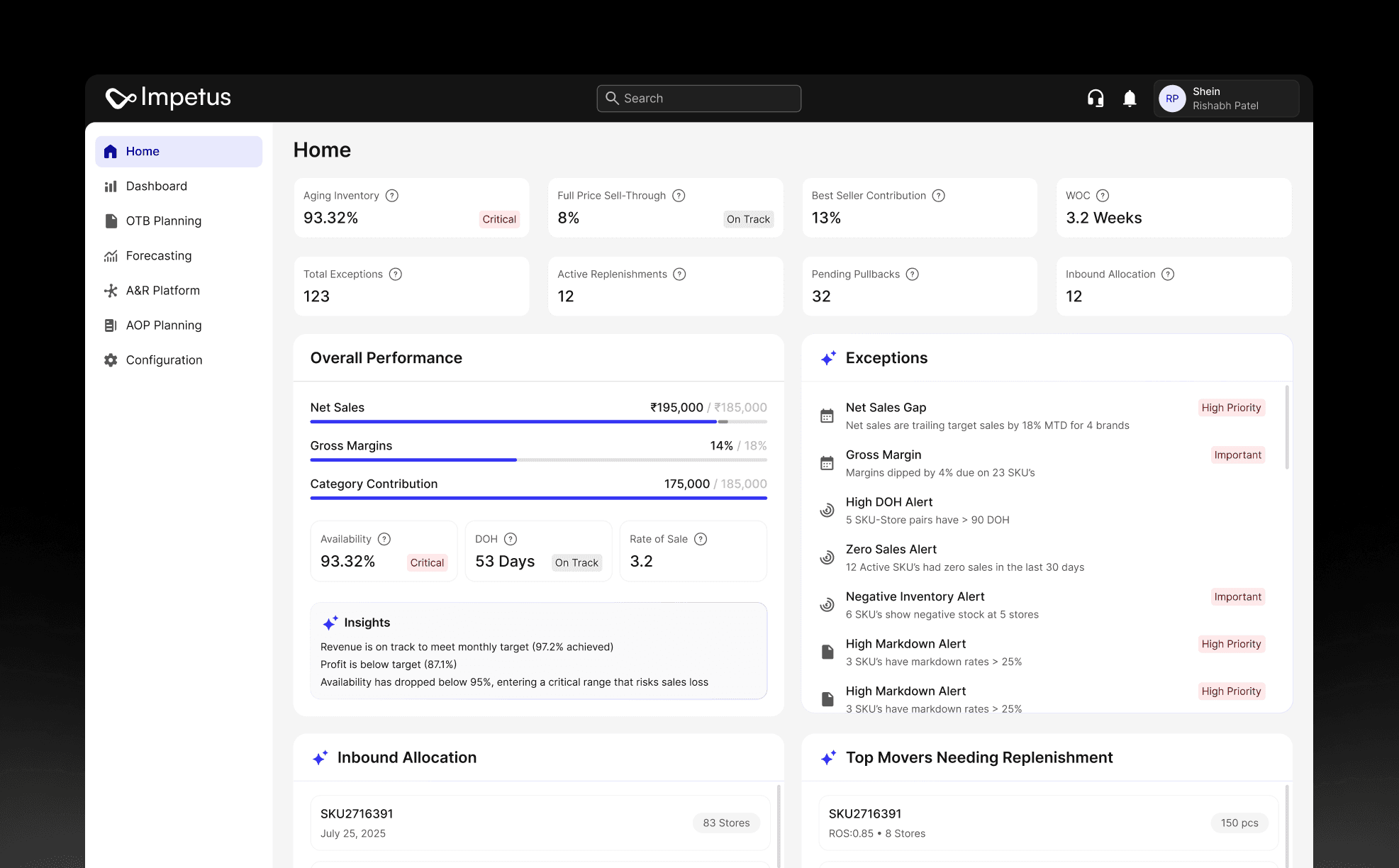
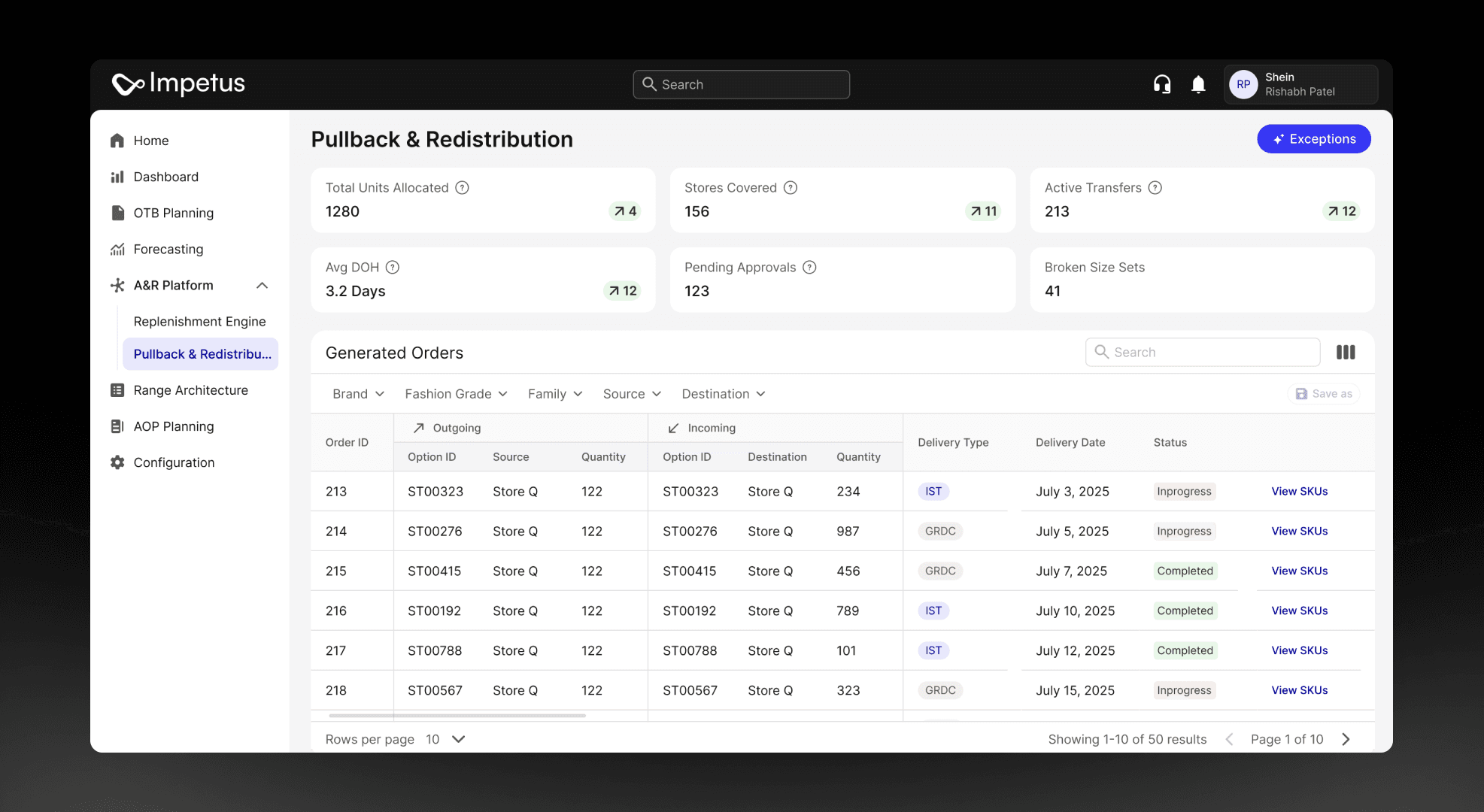
Created Allocation & Replenishment Panel: Which auto-runs inter-store transfers, exceptions, and redistributions from one store to another.
Created Allocation & Replenishment Panel: Which auto-runs inter-store transfers, exceptions, and redistributions from one store to another.
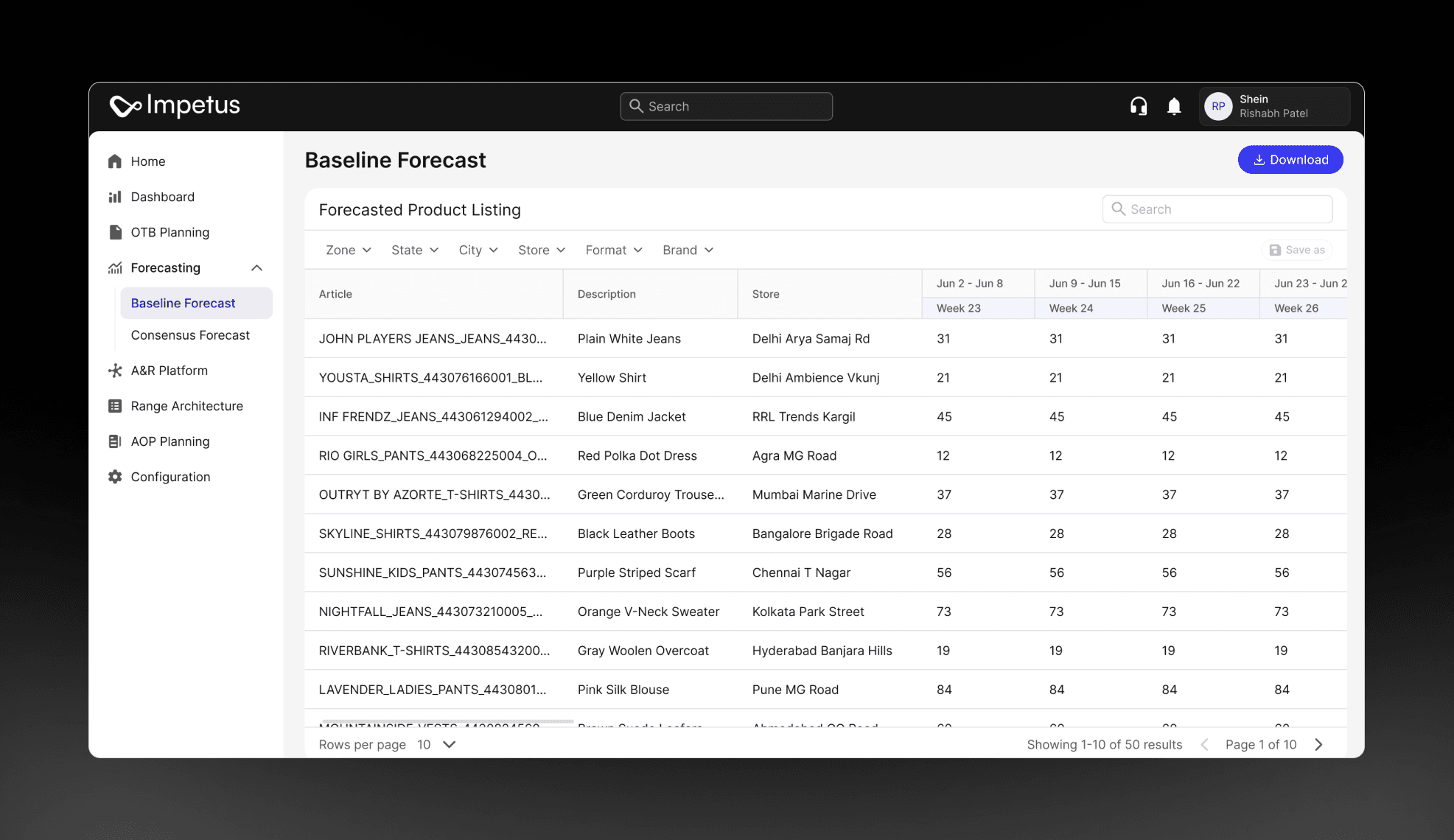
Forecasting Module: Interactive table displaying forecasts per SKU with planner override option.
Forecasting Module: Interactive table displaying forecasts per SKU with planner override option.
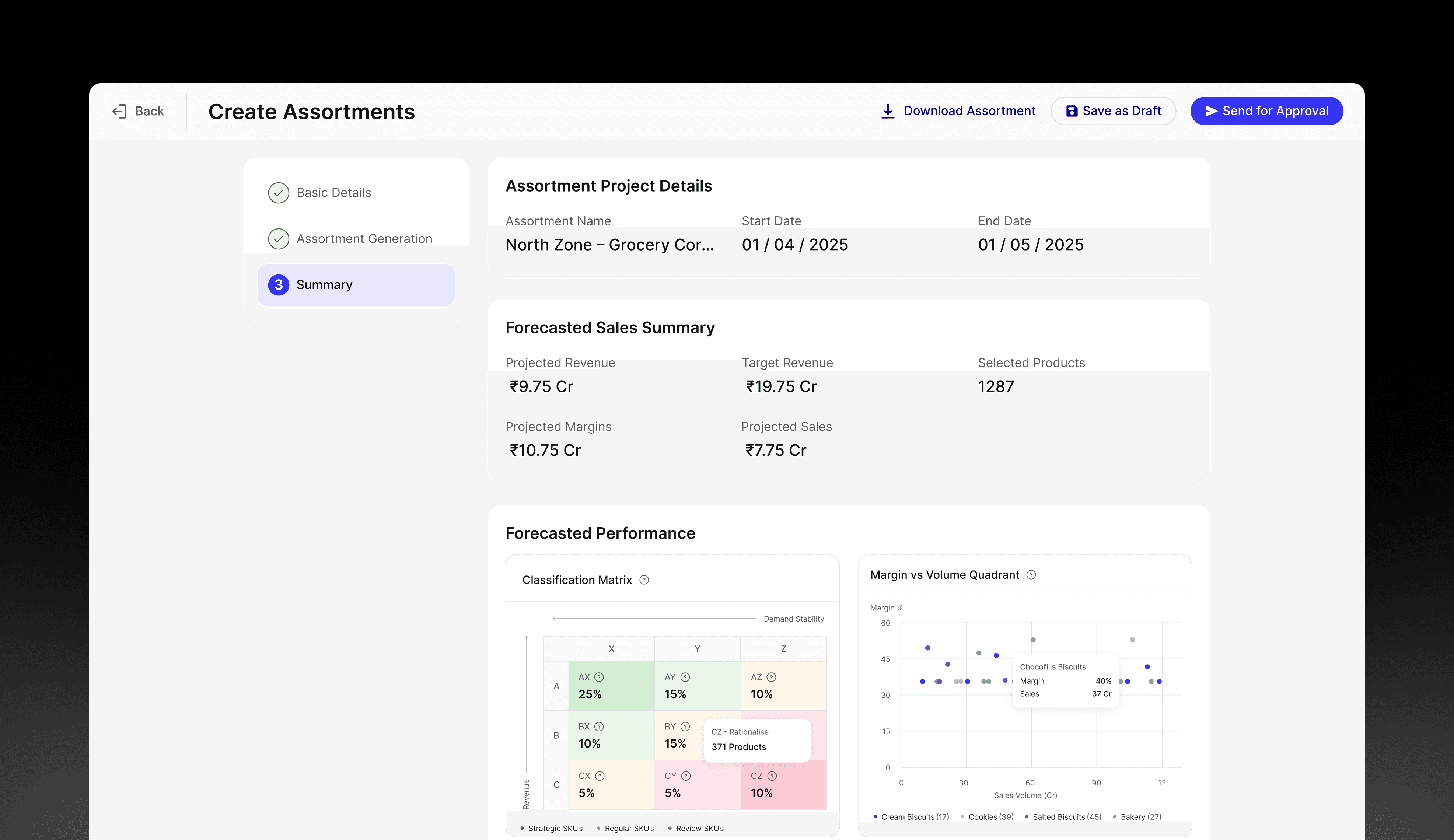
Assortment modules for creating assortments that can easily be created for better planning. It also determines what products are going in what stores in the batch.
Assortment modules for creating assortments that can easily be created for better planning. It also determines what products are going in what stores in the batch.
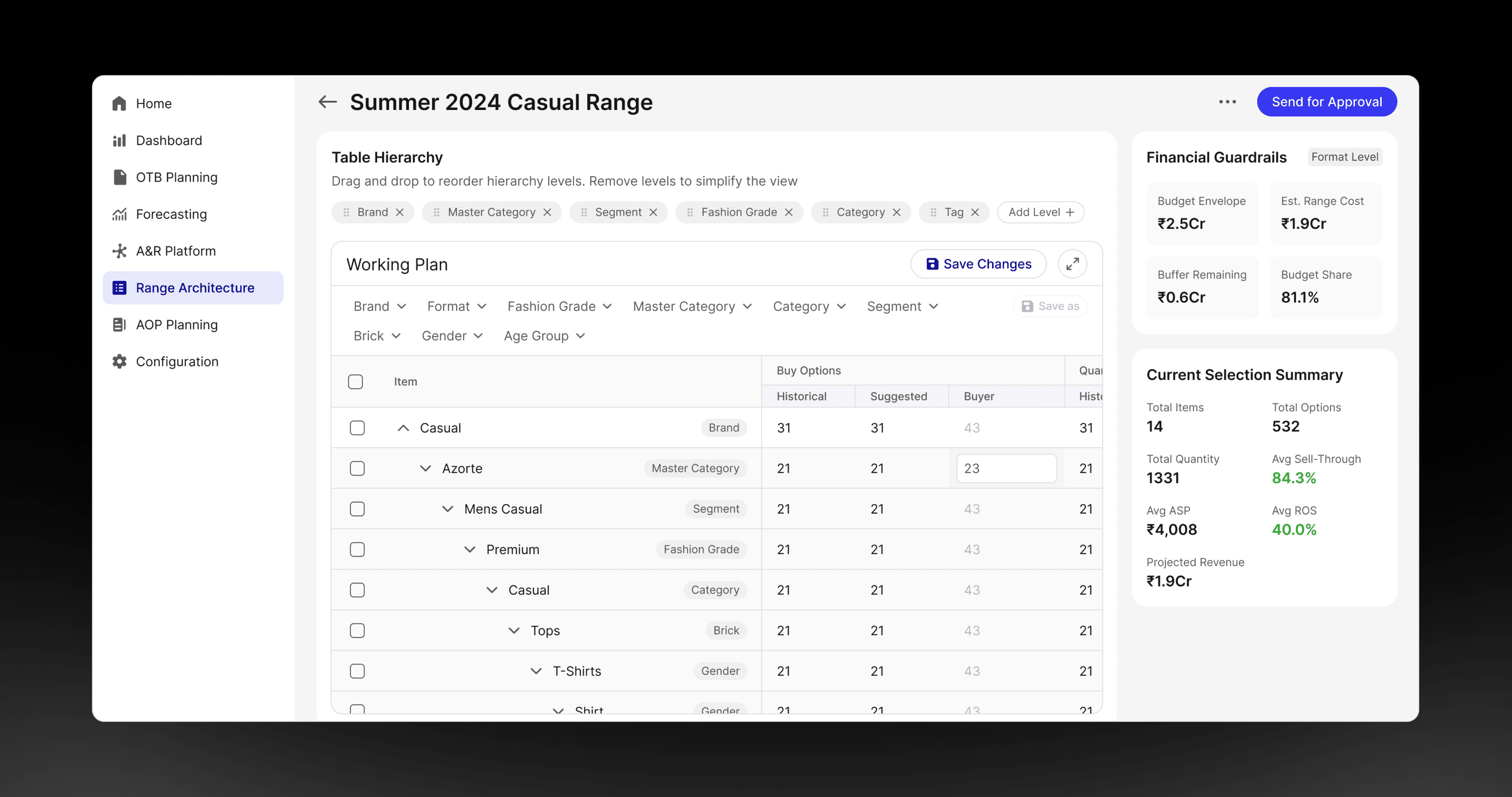
Created a module for range architecture that defines the strategic structure of a product range. How categories, price points, and styles are distributed across store tiers or clusters.
Created a module for range architecture that defines the strategic structure of a product range. How categories, price points, and styles are distributed across store tiers or clusters.
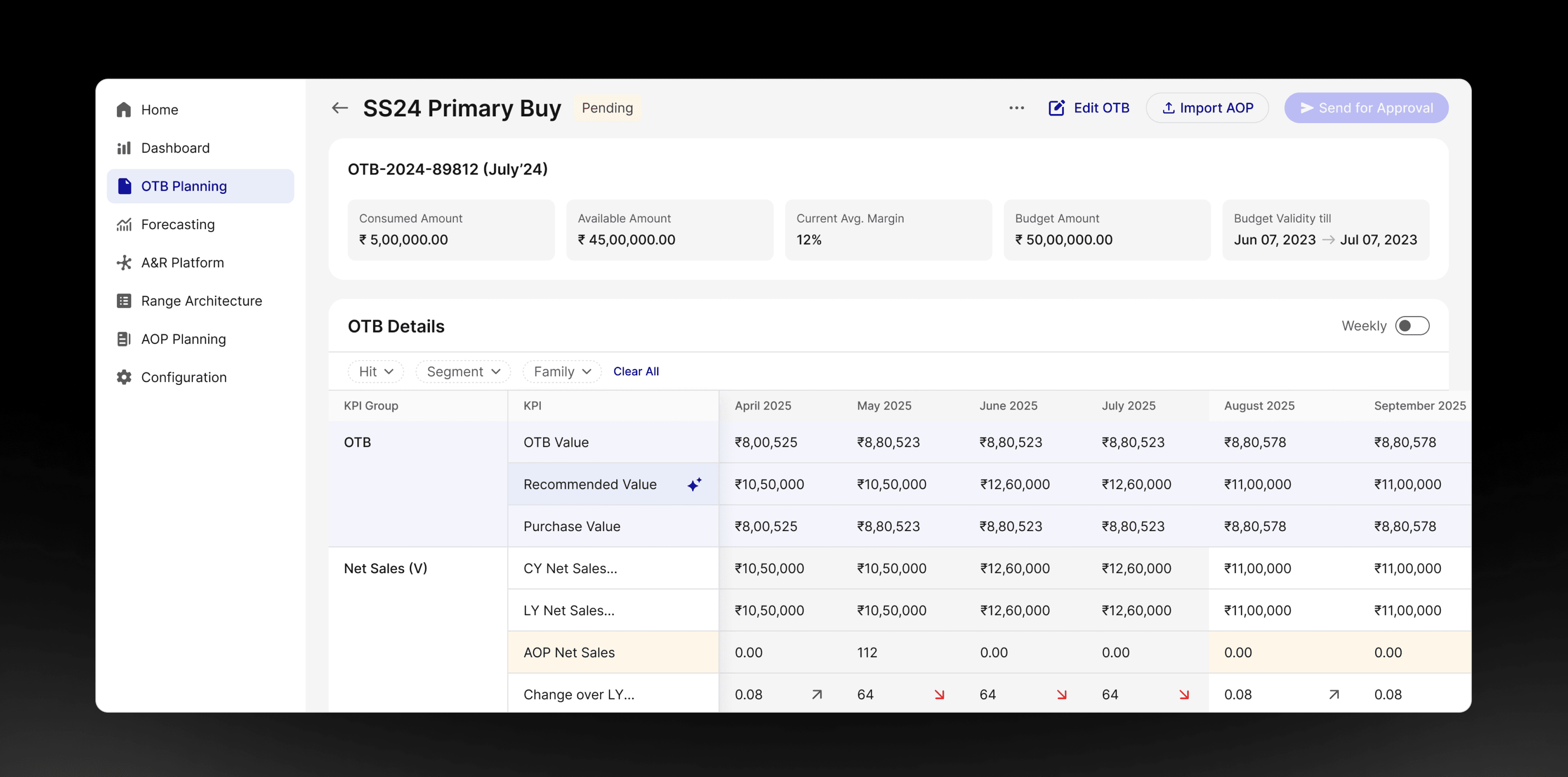
OTB Module includes targets for all categories. OTB translates those targets into periodic buying budgets to ensure inventory spending stays within plan.
OTB Module includes targets for all categories. OTB translates those targets into periodic buying budgets to ensure inventory spending stays within plan.
About the Project
The Unified Planning Platform was built for Reliance Retail’s omnichannel business, creating two critical systems Granary (AI forecasting) and A&R (allocation and replenishment) into one intelligence layer.
It aimed to enable data-driven inventory movement: predicting demand, allocating inventory, and redistributing stock in real-time to reduce waste and avoid stockouts.
Goal
Create a single Unified Retail Planning Platform (integrating assortment planning with allocation & replenishment) to automatically stock the right products in the right quantities at the right time and place, thereby boosting on-shelf availability and cutting waste.
Industry Insights
In retail tech, there’s a trend towards unified planning solutions that breaks down silos between merchandising and supply chain.
Traditional enterprise tools like SAP and even newer AI solutions (e.g. RELEX, o9 Solutions) offer robust planning capabilities, but often operate in separate modules or lack user-friendly UX.
Who is the User?
We kicked it off with a discovery phase to ground the design in real user needs and data. This included:
Stakeholder Workshops: Conducted 2 workshops with business leaders and the planning team to understand goals, current process pain points, and success metrics. Interviewed 6 planners and category managers (across grocery and fashion departments) to learn how they currently plan assortments and manage inventory.
Business Heads
Track KPIs like fill rate, sell-through, and aging stock
Category Managers
Monitor category health and make approval decisions
Planners
Manage store-level inventory and forecasts
Understanding the Lifecycle of the Business
Key Painpoints
Fragmented Workflow
They had to manually transfer data between systems, causing errors and wasted time.
Lack of Visibility
Disconnected tools caused poor visibility into DC inventory, stock cover, and lead time.
Slow Reactions
Stockouts & overstocking went unnoticed for days due to delayed reports.
User Experience Gaps
The existing tools were not user-friendly and information overload on screens.
No Intelligence
No automated redistribution or pullback; aging stock was manually tracked.
Emotional Aspect
Felt frustrated they were accountable for sales but didn’t feel the tools empowered them.
Leadership Insights
Strategic Alignment
Employers are rapidly adopting automation in recruitment, 68% of companies are expected to have AI-driven hiring
Better Matching & Outcomes
69% of job seekers who used ChatGPT for their resume saw a higher response rate from employers
Recruiter Efficiency Gains
Now, algorithms can cut initial screening time by up to 75%, turning days of work into minutes
UX Challenges
Data Density vs. Clarity
The platform deals with huge amounts of data hundreds of SKUs, dozens of stores, and forecast numbers for each.
AI Interpretability
Since the system’s recommendations come from ML models, we had to design for transparency.
User Control & Overrides
While automation is key, planners insisted on the ability to override or adjust suggestions easily.
Getting Quick Approvals
Vibe-coded the solutions for quick business approvals
Forecasting Dashboard
Demand predictions, uncertainty bands, feature importance.
A&R Engine
Auto-runs daily replenishment and bi-weekly pullbacks with exception alerts.
Insights Layer
KPIs, override justification, and approval workflows.
Quantitative Results:
+92% Forecast Volume Accuracy (vs. previous 68% baseline).
+92% Forecast Volume Accuracy (vs. previous 68% baseline).
30% Broken Size identified pre pullback automation.
30% Broken Size identified pre pullback automation.
+98% Replenishment SLA achieved in pilot phase.
+98% Replenishment SLA achieved in pilot phase.
40% reduction in planner decision time.
40% reduction in planner decision time.
Aged stock reduced by 20% within 6 weeks
Aged stock reduced by 20% within 6 weeks
Qualitative Results:
Planners gained trust in the system through transparent AI recommendations
Planners gained trust in the system through transparent AI recommendations
Category managers could monitor end-to-end lifecycle from forecast to clearance.
Category managers could monitor end-to-end lifecycle from forecast to clearance.
The platform shifted decision-making from reactive to proactive.
The platform shifted decision-making from reactive to proactive.
Next Steps:
Integrate markdown and liquidation logic to close the inventory lifecycle loop.
Integrate markdown and liquidation logic to close the inventory lifecycle loop.
Extend configuration UI for seasonal logic and OTB (Open-To-Buy) planning.
Extend configuration UI for seasonal logic and OTB (Open-To-Buy) planning.
Scale to all Reliance formats (Trends, Smart, Fresh, Digital Commerce).
Scale to all Reliance formats (Trends, Smart, Fresh, Digital Commerce).
Introducing Inventory Management System for Reliance Retail
Created Home Dashboard: Unified KPI view forecast accuracy, fill rate, WOS (weeks of stock), and aged inventory.
Created Home Dashboard: Unified KPI view forecast accuracy, fill rate, WOS (weeks of stock), and aged inventory.
Created Allocation & Replenishment Panel: Which auto-runs inter-store transfers, exceptions, and redistributions from one store to another.
Created Allocation & Replenishment Panel: Which auto-runs inter-store transfers, exceptions, and redistributions from one store to another.
Forecasting Module: Interactive table displaying forecasts per SKU with planner override option.
Forecasting Module: Interactive table displaying forecasts per SKU with planner override option.
Assortment modules for creating assortments that can easily be created for better planning. It also determines what products are going in what stores in the batch.
Assortment modules for creating assortments that can easily be created for better planning. It also determines what products are going in what stores in the batch.
Created a module for range architecture that defines the strategic structure of a product range. How categories, price points, and styles are distributed across store tiers or clusters.
Created a module for range architecture that defines the strategic structure of a product range. How categories, price points, and styles are distributed across store tiers or clusters.
OTB Module includes targets for all categories. OTB translates those targets into periodic buying budgets to ensure inventory spending stays within plan.
Quantitative Results:
+92% Forecast Volume Accuracy (vs. previous 68% baseline).
30% Broken Size identified pre pullback automation.
+98% Replenishment SLA achieved in pilot phase.
40% reduction in planner decision time.
Aged stock reduced by 20% within 6 weeks
Qualitative Results:
Planners gained trust in the system through transparent AI recommendations
Category managers could monitor end-to-end lifecycle from forecast to clearance.
The platform shifted decision-making from reactive to proactive.
Quantitative Results:
+92% Forecast Volume Accuracy (vs. previous 68% baseline).
30% Broken Size identified pre pullback automation.
+98% Replenishment SLA achieved in pilot phase.
40% reduction in planner decision time.
Aged stock reduced by 20% within 6 weeks
Next Steps
Integrate markdown and liquidation logic to close the inventory lifecycle loop.
Extend configuration UI for seasonal logic and OTB (Open-To-Buy) planning.
Scale to all Reliance formats (Trends, Smart, Fresh, Digital Commerce).